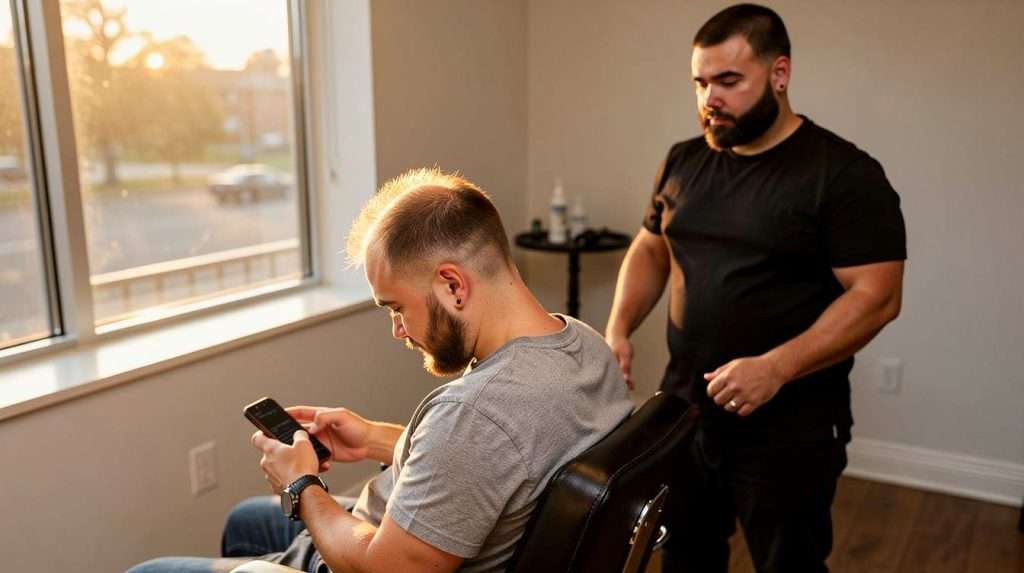
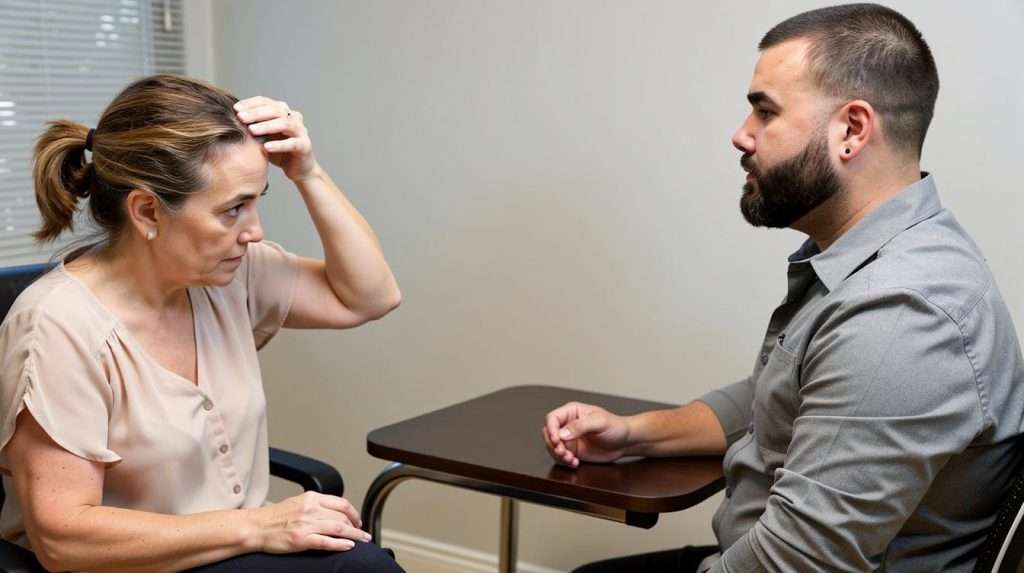
You can see crown thinning clearly under certain lights, and nothing makes it more obvious than standing beneath an overhead lamp or stepping outside on a bright day. The crown behaves differently to every other part of the scalp during SMP treatment, and understanding why changes what you should expect, what you should ask, and why the detail work at the top of your head matters so much.
Why the crown creates unique challenges for SMP coverage
The crown sits at the apex of the scalp, which means light hits it from directly above. That single fact changes everything. On the sides and back of the head, light arrives at an angle and shadows do a lot of the work for you, making pigment sit naturally within the hair. At the crown, there’s nowhere to hide.
When I work on the crown area, I’m always thinking about what the scalp looks like under the harshest possible lighting conditions, not just in a dimly lit barber’s mirror. If the placement isn’t precise, flat overhead light will expose the dots rather than blend them. That’s a visible result, and not the one either of us wants.
There’s also the question of density graduation. True hair thinning at the crown rarely creates a clean, defined edge. It tends to fade outward in a gradual arc, with denser hair at the perimeter and an increasingly sparse field towards the centre. Matching that natural fade with scalp micropigmentation in the crown area requires a layered, patient approach across multiple sessions rather than a single dense pass.
The whorl pattern and why it changes how pigment must be placed
Every man has a natural whorl at the crown, a spiral point from which hair radiates outward in different directions. In a full head of hair, this is barely noticeable. In a man with thinning hair, it becomes the focal point of the entire scalp, and it demands specific technical attention during SMP treatment.
The follicles around a whorl don’t all point the same way. They fan out in a circular pattern, which means the angle of each individual pigment dot needs to shift as you move around the spiral. Place every dot at the same angle and the result looks artificial, because real hair at the crown never grows that uniformly. I adjust my needle angle continuously as I move around the whorl, following the natural rotation of the pattern.
The centre of the whorl also tends to be the most exposed point on the scalp. It often catches the light first and reflects it most directly. I typically work with a slightly lighter pigment density right at the apex and build outward, which mirrors how natural hair behaves and avoids creating a bull’s-eye effect under bright conditions.
Pigment selection and depth for the crown area
Pigment choice at the crown is not the same as pigment choice at the hairline. The hairline benefits from slightly crisper, more defined dots that mimic closely cropped stubble at the front. The crown calls for softer, slightly diffused impressions that read as depth and texture rather than individual follicles.
I use a finer needle configuration for the crown and work at a shallower depth than I would at the temples. Going too deep at the crown risks migration over time, where the pigment spreads and loses its definition, leaving a blurred patch rather than a textured field. Shallow, precise placement holds its shape and ages cleanly.
Colour matching is equally important. The crown is often where grey hairs first appear in men with mixed pigmentation, and a scalp micropigmentation treatment that ignores that reality will look out of place within a year or two. I factor in the existing grey-to-dark ratio and blend my pigment tones accordingly, so the treated area ages in step with the surrounding hair.
What a realistic SMP crown density result actually looks like
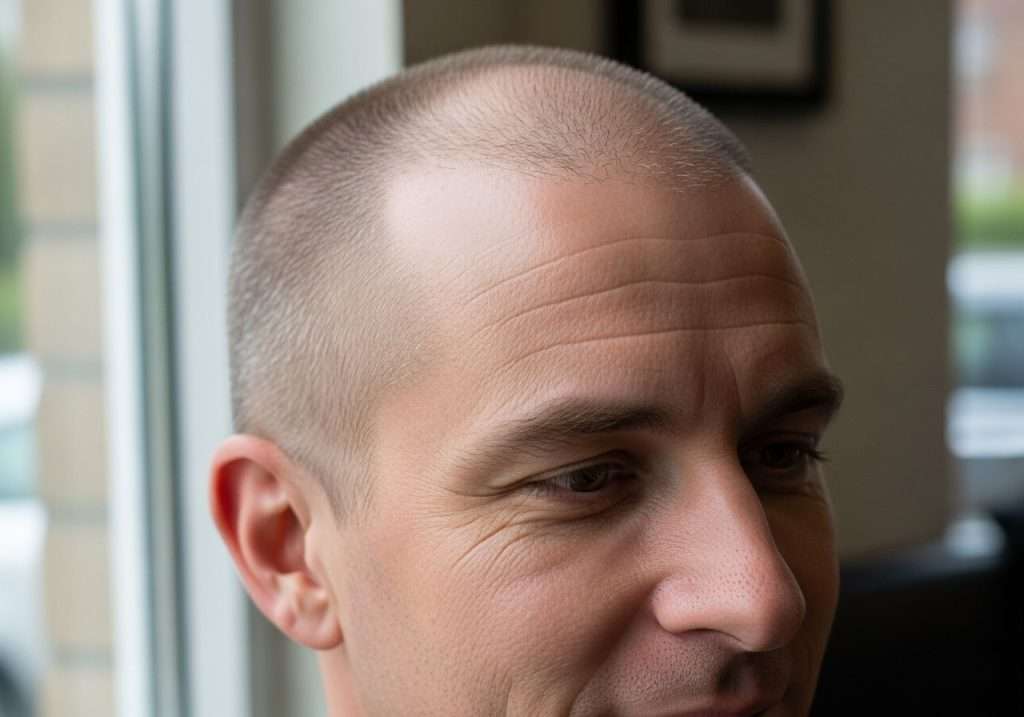
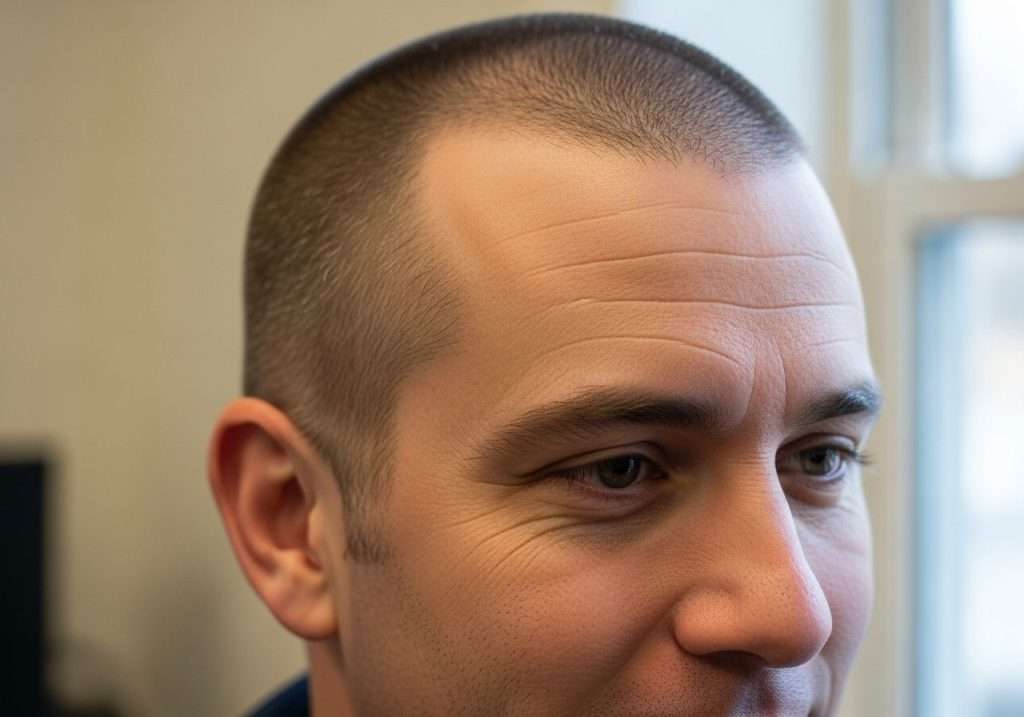
The goal for male density SMP at the crown is not to simulate a full head of hair. It is to restore the visual impression of density, to close the contrast gap between scalp skin and hair so the thinning area no longer draws the eye. Done well, it reads as a naturally close-cropped finish, consistent with the hair you still have.
Most crown treatments require two to three sessions, spaced four to six weeks apart, to build the layered density that holds up across different lighting conditions. The first session lays the foundation. The second refines depth and graduation. The third, if needed, addresses any areas where the pigment has settled lighter than intended.
I’ve worked on hundreds of crowns over my career, and the ones that look the best are always the result of restraint rather than aggression. Less pigment, placed with precision, beats heavy coverage every time. The crown rewards patience, and that patience shows in the finished result.
Frequently Asked Questions
Is the crown area more painful to treat with SMP than other parts of the scalp?
Most men report the crown as moderately comfortable, similar to the mid-scalp. The hairline and temples tend to be more sensitive because the skin sits closer to the bone. Crown skin is generally thicker, which often makes the SMP session in that area easier to tolerate than clients expect going in.
How many SMP sessions does it take to achieve good crown density?
Crown SMP density typically requires two to three sessions. The first session establishes the base layer, the second refines graduation and depth, and the third corrects any areas that settled lighter than planned. Sessions are spaced four to six weeks apart to allow the pigment to settle before the next layer is added.
Will SMP at the crown look natural if I still have some hair there?
Yes, and this is actually the most common scenario for male density SMP. The pigment is matched to your existing hair tone and placed to blend with the hair you still have, rather than replace it. The result reads as a closer, fuller crop rather than an obvious cosmetic treatment, provided the placement and colour are right.
Does the whorl pattern affect how long the SMP result lasts at the crown?
The whorl itself doesn’t affect longevity, but placement technique does. Pigment placed at the correct depth and angle within the whorl pattern holds its definition far longer than dots placed uniformly without accounting for follicle direction. A scalp micropigmentation artist who understands crown anatomy will produce results that age cleanly over time.
Can SMP at the crown cover a visible skin patch, or only blend thinning hair?
SMP can address both, though the approach differs. A visible scalp patch with little remaining hair needs more careful density building across multiple sessions. Thinning hair with residual coverage is generally more straightforward. In both cases, the crown hair tattoo technique involves layering pigment gradually to avoid an unnatural, overly dense appearance in the treated area.